
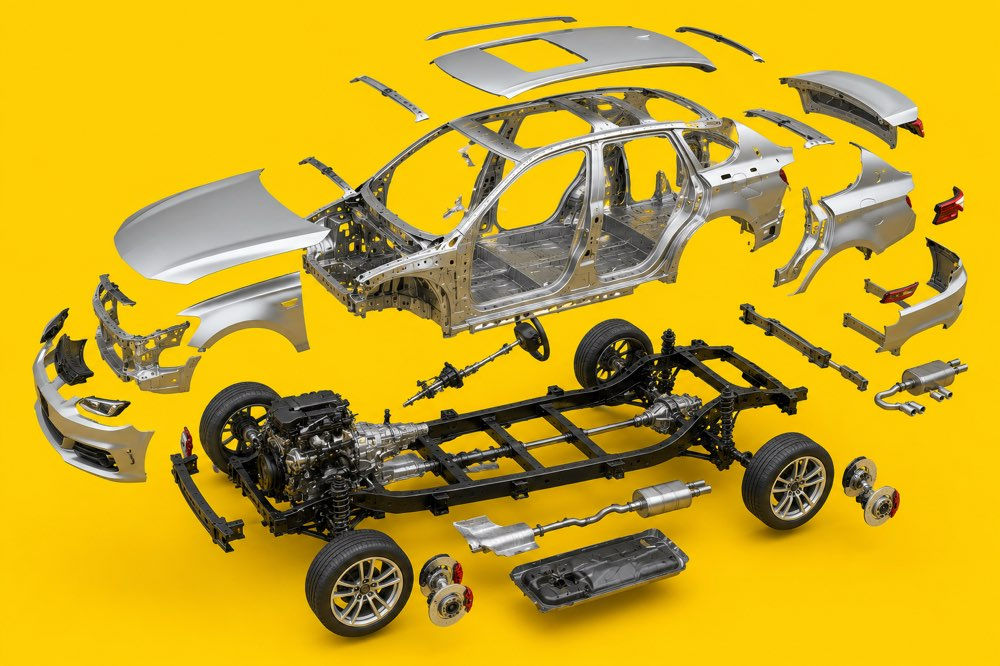
Types of Body Frames Used in Cars

Every car is built around a structural framework that provides strength, supports the engine and suspension, and protects occupants during a collision. The type of body frame used in a vehicle has a major influence on its safety, handling, comfort, durability and intended purpose.
Join us on the WhatsApp Community for automotive updates.
While there are several body frame designs, modern automobiles primarily use either a monocoque (unibody) construction or a body-on-frame design. Some high-performance and racing vehicles also employ specialised structures such as space frames and carbon fibre monocoques.
1. Monocoque (Unibody) Construction

Monocoque, also known as unibody construction, is the most common body structure used in modern passenger vehicles. In this design, the body and chassis are integrated into a single load-bearing structure instead of being built separately.
Because the entire body contributes to the vehicle’s strength, monocoque construction is lighter than traditional frame designs while maintaining excellent structural rigidity. Engineers also design specific crumple zones that absorb crash energy during collisions, significantly improving occupant safety.
Advantages
Lightweight construction
Better fuel efficiency
Improved crash protection
Superior ride comfort and handling
Lower manufacturing costs
Common Applications
Hatchbacks
Sedans
Crossovers
Most compact and midsize SUVs
2. Body-on-Frame (Ladder Frame) Construction

Body-on-frame construction uses a separate steel chassis on which the vehicle body is mounted. This design has been used for decades in trucks and heavy-duty SUVs because of its exceptional strength and durability.
The separate frame allows the vehicle to withstand heavy loads, towing duties and demanding off-road conditions without placing excessive stress on the body.
Advantages
Extremely durable
Excellent towing capacity
High load-carrying capability
Ideal for off-road driving
Easier to repair after heavy-duty use
Disadvantages
Heavier than unibody vehicles
Lower fuel efficiency
Less refined ride quality
Higher centre of gravity
Common Applications
Pickup trucks
Large SUVs
Commercial vehicles
3. Space Frame Construction

A space frame consists of an interconnected network of steel or aluminium tubes that forms the primary structural skeleton of the vehicle. The exterior body panels generally provide little structural support and mainly serve aerodynamic and styling purposes.
This design offers an excellent balance between strength and weight, making it suitable for sports cars and motorsport applications.
Advantages
Very lightweight
High structural rigidity
Excellent performance characteristics
Common Applications
Sports cars
Race cars
Prototype vehicles
4. Carbon Fibre Monocoque

Carbon fibre monocoque construction is an advanced version of the unibody concept. Instead of steel, the main structure is manufactured from carbon fibre composites, producing an exceptionally strong yet incredibly light chassis.
Although this technology delivers outstanding performance and crash protection, its high manufacturing cost limits its use to premium supercars, hyper-cars and Formula racing cars.
Advantages
Exceptional strength-to-weight ratio
Outstanding crash protection
Maximum chassis rigidity
Superior performance
Common Applications
Supercars
Hypercars
Formula racing cars

Which Body Frame Is Best?
There is no single body frame that is ideal for every vehicle. The best choice depends on the vehicle’s intended purpose.
Monocoque construction is best suited for everyday passenger cars because it offers excellent safety, fuel efficiency and driving comfort. Body-on-frame construction remains the preferred option for vehicles that frequently tow heavy loads or operate in demanding off-road environments. Space frames and carbon fibre monocoques are primarily reserved for high-performance vehicles where reducing weight and maximising rigidity are critical.
Join us on the WhatsApp Community for automotive updates.


Comments